
Agentic Merchandising Vendor Red Flags: 6 Questions to Ask Before You Sign

Every "agentic merchandising" vendor pitch sounds the same right now: autonomous, AI-native, built different. A VP of ecommerce sitting through three of these demos a week needs a way to separate a defensible platform from a wrapper the next model release erases. Syntheum's agentic merchandising platform team put together the six red flags, and the one diligence question, worth running before you sign anything.
The deck has fourteen slides, and the word "agentic" shows up on six of them. The vendor rep is thirty minutes into a demo of a merchandising tool that promises to think like your best merchandiser, at scale, forever.
Somewhere around slide nine, someone in the room asks the only question that actually matters, and the rep pauses half a second too long before answering. That pause is the whole story.
A lot of what gets sold as "AI-native" right now is a thin layer of prompts wrapped around somebody else's foundation model, and the vendor pitching it has no good answer for what happens to their product once that model gets better. Richard Dulude, a venture investor, wrote a piece called "The Middleware Squeeze" that names this pattern precisely: platforms climb the stack and absorb the layer built directly on top of them, and it's happening to AI products in quarters instead of a decade perspective.
If you're the one sitting through that demo, that framework is worth more to you as a buyer than it is to any vendor as a pitch. Here's how to use it.
The pitch always sounds the same
Swap out the vendor's name on that deck and the sentence still sounds familiar: intelligent, seamless, built for the modern merchandising team. None of it is wrong. Yet none of it tells you anything.
That's not an accident of lazy copywriting. A lot of this language now gets drafted by the same handful of AI models, trained on overlapping public case studies, prompted with some version of "write a compelling SaaS pitch," and optimized against the same search-engine best practices everyone else is optimizing against. Researchers studying competition and diversity in generative AI have started documenting what happens next: outputs regress toward the mean, and the mean gets more crowded every quarter.
Call it algorithmic monoculture. When everyone uses similar tools, trained on overlapping data, to answer the same prompt, the language converges.
A LinkedIn post about "the future of AI in retail" reads like the last five. A product description written by a model with no real product context sounds like every other product description written by a model with no real product context. Search results fill up with the same "ultimate guide to X" structure no matter who's publishing it.
Somewhere in all that convergence, the actual differences between products get smoothed into the same safe, technically correct, forgettable middle.
That matters here for a specific reason. Not that sameness in marketing copy is embarrassing, it's that it breaks the one thing a buyer, or a search engine, or an AI answer engine, actually needs from a vendor pitch: a signal. If every vendor's language collapses toward the same statistically average answer, whatever's evaluating those vendors, human or machine, has less to actually tell them apart by. The best answer stops being the most useful one and starts being the most familiar one.
Worth remembering on the way into the next demo.
One question worth more than the whole deck
Worth writing on an index card and bringing to the next demo: if the large language model inside this vendor's product got twice as good tomorrow, does their product get stronger, or does that improvement threaten it?
Sit with how a vendor answers that, not just what they say. A thin wrapper around somebody else's model gets less defensible every time that model improves: the model is slowly doing everything the wrapper used to charge for.
A product built around proprietary workflow, business context, and orchestration gets more valuable when the model improves: a smarter model makes that accumulated context worth more, not less. Ask it plainly. "If the model you're built on got twice as good tomorrow, does your product get better or does it get replaced?"
Most vendors haven't rehearsed an answer to that one. The good ones don't need to.

The checklist: what to actually ask
Bring six questions into the next vendor conversation, whether it's a demo, an RFP response, or a renewal call. None of these require you to understand the underlying technology, they just require the vendor to be specific instead of confident, the same specificity good merchandising operations has always demanded, model or no model.
-
If the underlying model got twice as good tomorrow, does this product get more valuable, or does it get replaced? Ask this one first.
-
What do you know about my business that a general-purpose model doesn't, and where does that knowledge actually come from? "Shopper behavior" isn't a good enough answer. Every vendor in the room says that.
-
Where exactly does your product sit the moment my shopper decides to buy? A tool that only shows up in an AI answer engine's summary box isn't in the room when the sale happens.
-
Walk me through one business rule your system enforces that a general-purpose chatbot couldn't. Margin logic, inventory constraints, a category-specific exception, something with teeth.
-
What happens to my setup if I switch foundation models next year, or my shoppers start arriving through a different AI platform entirely?
-
Show me one customer where a smarter underlying model made your product measurably better, not just faster. If nobody can point to one, that's an answer too.
Print that list. Lean on it like it’s the Gettysburg Address. Half these vendors have never been asked any of it out loud.
Watch how they answer
McKinsey published research this year finding that 71 percent of merchants say AI merchandising tools have had a limited effect on their business, or none at all. A lot of what got bought over the last two years was a thin wrapper riding a rising floor, which stopped doing the vendor's job for them the moment a customer asked “what happens next?”.
The pattern is easy to spot once you know what you're listening for.
You'll know the difference within about ten seconds. If auditing your current search and merchandising setup hasn't made it onto the calendar this quarter, a vendor conversation that goes this badly is as good a reason as any to put it there.
FAQ: what buyers actually need to know
How do I know if my current AI merchandising tool is in the squeezed middle?
Ask it the same question you'd ask a new vendor: if the underlying model got twice as good tomorrow, would the tool you already bought get more valuable, or would it get replaced? If your account team can't answer that with specifics, you likely already own a wrapper.
What should a merchandising team actually do about this?
Audit what you're paying for against four things: proprietary context the vendor actually owns, workflow ownership at the moment of purchase, business logic deep enough to handle your category's edge cases, and independence from any single foundation model or AI shopping platform, the exact shift next year's ecommerce landscape is already pointing toward. A tool missing all four is exposed every time a lab ships a new release.
What questions should I ask vendors claiming to be "AI-native"?
Start with the six in the checklist above. The first one, whether the vendor's product gets stronger or gets replaced as the underlying model improves, tends to surface everything else in how it's answered.
What does "AI-native" actually mean?
Depends entirely on who's saying it. Sometimes it means a product built from the ground up around proprietary data and workflow orchestration. Just as often it means a chat interface sitting on top of a general-purpose model with a system prompt doing most of the work. The label alone tells you nothing. The six questions do.
Is every AI-native vendor a bad bet?
No, and treating the label itself as a red flag would be its own mistake. Some of these products genuinely own proprietary context and workflow that gets more valuable as the underlying models improve. The point isn't to distrust the category. It's to stop taking the word for it.
Ask it before you sign anything
Go back to that vendor demo. Fourteen slides that could have come from any vendor in the category, six mentions of "agentic," and a rep who paused half a second too long on the one question that mattered.
Fourteen interchangeable slides is the monoculture talking. The pause is what happens when a vendor gets asked something the monoculture doesn't have a template for. That pause wasn't a bad answer. It was the absence of one, and the absence tells you almost everything you need to know before you sign anything.
Ask earlier next time. Slide two, not slide nine.


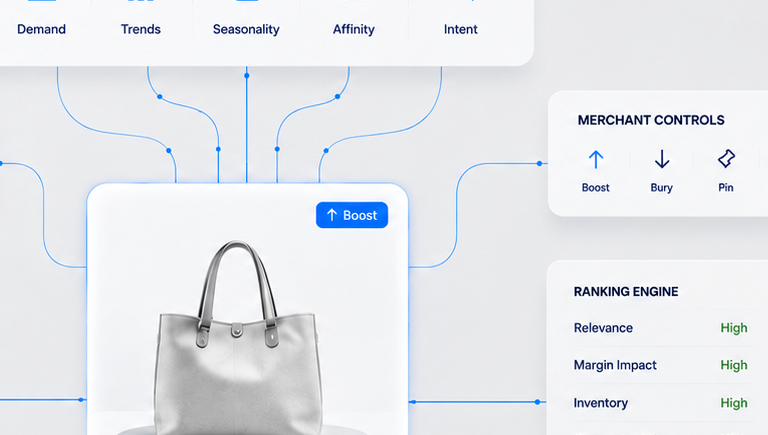

Empower Merchants with Ease and Intelligence
Syntheum is the Semantic Merchandising Platform for Agentic Commerce - powering onsite search, conversational shopping, and AI discovery through one merchandising brain your team controls.