
2026 Ecommerce Predictions: Five Transformative Paradigm Shifts

Once upon a time, a wise man named Yogi Berra said, "It's difficult to make predictions, especially about the future".
On the surface that quote seems very simple. Even given Berra's reputation for offbeat wisdom. You might even be tempted to reply, "Tell me something I didn't already know". But its tongue-in-cheek relevance to ecommerce and digital marketing predictions for 2026 is there.
Yogi was a master of a game built on statistics, yet he is reminding us that even in the data‑rich, prediction-friendly, sport of baseball, the future is still stubbornly uncertain. Every forecast, no matter how confident, is still a bet.
And yet... the team at Syntheum.ai have thought long and hard about the 5 wagers placed below. So, at a minimum, we're making them with confidence and hope they add to the larger conversation for this potential paradigm shift of a new year.
It’s already January 9th. You’re back at your desk. The holiday numbers are in, and they’re… weird.
Traffic was up, but sessions were shorter. Conversion looked good on paper, but your attribution software is fighting with your finance team about where the sales actually came from. And half your team is panicked because a Google update just changed how their AI summarizes your product descriptions.
Every year, pundits throw out lists of predictions. You know the drill: "Personalization will be key," or "Video commerce is taking over." It’s mostly noise. Safe bets wrapped in buzzwords.
This isn’t that list.
The shift happening right now isn’t about humans suddenly handing all of their shopping to autonomous agents. It’s about specific, high‑leverage pockets where delegation is already starting to matter - places like ChatGPT and Gemini - where shoppers are asking questions, getting shortlists, and making decisions without ever touching your site.
Your advantage in 2026 won’t come from screaming that “agentic commerce is taking over,” but from targeted aggression: choosing the few channels that actually move the needle and designing focused strategies for how your brand shows up, merchandises, and wins inside them.
1. "Search" Stops Being a Page. It Becomes a Hand-off
For the last twenty years, "search" has meant a specific sequence of events:
-
User types "men’s waterproof hiking boots."
-
User sees a grid of 24 products.
-
User clicks, scrolls, filters, clicks again.
-
User decides.
That model is dying. Fast.

In 2026, search isn’t a destination page. It’s a delegation layer.
Think about how you use ChatGPT or Gemini today. You don't want a list of links; you want an answer. That behavior is bleeding into commerce. Shoppers are tired. The "paradox of choice" is real. They don't want to browse 500 SKUs of beige sofas.
They want to say: "Find me a beige sofa that fits a 10-foot wall, is cat-proof, costs under $1,200, and can be here by Tuesday."
And they want Shopify / Salesforce to just handle it.
The Rise of "Agent Win Rate"
This changes the math of digital merchandising.
If the selection happens before a human ever sees a result set, your standard KPIs are toast. Click-through rate (CTR)? Irrelevant if the user never clicked. Time on site? Who cares if the transaction happened in the chat interface?
Brands are about to enter a brutal war for a new metric: Agent Win Rate.
This is the percentage of times your product makes the shortlist when a digital agent is doing the shopping. If an AI evaluates 50 options and presents three to the user, and you aren't in those three, you don't exist. You can’t retarget your way out of that. You can’t "interrupt" the user with a pop-up.
Merchandising teams that are still obsessing over the visual arrangement of a category page are solving a problem that is rapidly disappearing. The battle isn't for the user's eye anymore; it's for the agent's logic.
2. The "Free Traffic" Hangover
Right now, everyone is excited about AI search. "Look!" they say. "Perplexity and ChatGPT are sending us traffic! It’s brand new volume!"
It feels like the early days of social media. Organic reach is high, the platforms need content, and the traffic feels free.
But we know how this movie ends.

By late 2026, the bill comes due. The big platforms - Google, OpenAI, Amazon - aren't building these massive reasoning engines out of charity. They are building them to capture value.
The Attribution Nightmare
Here’s the scenario: A customer asks their AI assistant for a recommendation. The assistant suggests your product. The customer buys it.
Who gets credit?
Did they buy it because of your brand equity? Or because the AI recommended it? And if the AI recommended it, the platform controlling that AI will eventually want a cut.
We’re going to see a shift where "Answer Engine Optimization" (AEO) stops being a fun experiment and becomes a painful line item in your P&L. Platforms will introduce "Sponsored Answers" or "Preferred Citations."
If you aren't paying, the AI might suddenly decide your competitor’s product is the "better answer" for that query.
Retailers are going to wake up to an uncomfortable truth: They are rebuilding a dependency on gatekeepers. The only difference is that these gatekeepers are harder to audit. A CFO is going to look at the marketing spend in Q3 2026 and ask, "Why are we paying a 15% 'referral fee' to an algorithm?"
And you won't have a good answer.
3. The Two-Layer Stack: Agents + Brakes
The instinct in tech is always speed. Automate everything. Remove the human.
That’s going to backfire. Hard.
The commerce stacks that win in 2026 won't be the ones with the most autonomy. They’ll be the ones with the best brakes.
We’re calling this the "Intern Model."

Think about how you manage a smart, enthusiastic intern. They can churn out a lot of work. They can summarize reports, draft emails, and pull data. But you don't give them the company credit card and the password to the production server on their first day.
You trust them progressively.
Enter "Agent Ops"
This is going to be the hiring craze of 2026. Not "Prompt Engineers" - that’s already dated - but Agent Operations Managers.
These are the people responsible for the "Trust Layer." They set the guardrails.
-
The Guardrails: An agent can change pricing, but only by +/- 5%. An agent can re-order stock, but only up to $10,000. An agent can rewrite product descriptions, but a human must review a sample of 50 every week.
-
The Kill Switch: When an agent starts hallucinating a discount code that doesn't exist (which will happen), can you shut it down in seconds? Or do you have to wait for IT to deploy a patch?
If you skip the brakes because you want to move fast, you’re asking for a disaster. You’ll be the company that accidentally sold 5,000 units at 99% off because the AI thought it was a "loyalty strategy."
4. Checkout Becomes a Protocol (Not a Button)
We have spent the last decade obsessing over the checkout experience. One-page checkout. Guest checkout. Apple Pay integration. Button color testing.
All of that assumes a human is tapping a screen.
In 2026, checkout becomes a protocol. It’s a digital handshake between a buyer’s agent and your backend system.

We have spent the last decade obsessing over the checkout experience. One-page checkout. Guest checkout. Apple Pay integration. Button color testing.
All of that assumes a human is tapping a screen.
In 2026, checkout becomes a protocol. It’s a digital handshake between a buyer’s agent and your backend system.
Salesforce is already telegraphing this with their support for "Agentic Commerce Protocol" (ACP). The idea is simple: If an agent wants to buy something, your store needs to be able to speak "Agent."
The "Invisible" Transaction
Imagine a user tells their phone: "Order the usual dog food, but get the bigger bag this time."
The agent goes to your site. It doesn't "see" your beautiful hero image. It doesn't care about your font choice. It’s looking for a structured API endpoint that confirms:
-
Is this the right product?
-
Is it in stock?
-
Can I execute the transaction securely?
-
Can I reverse it if I’m wrong?
If your site is built only for human eyes—if it relies on visual captchas, complex modal pop-ups, or weird redirect chains—the agent will bounce. It will go to a competitor that is "ACP-Ready."
Protocol ownership is going to be the new power dynamic. If you aren't compatible with the major agent protocols, you are effectively closed for business to the highest-value shoppers.
5. Merchandising Closes the Loop
Here is the reality of most merchandising teams today: They are reactive.
They look at last week’s sales report on a Monday. They see that the red sweaters didn't sell. They argue about why. They change the sort order manually. They wait another week to see if it worked.
That cycle time is too slow.
By 2026, the operating model is Closed-Loop Merchandising.
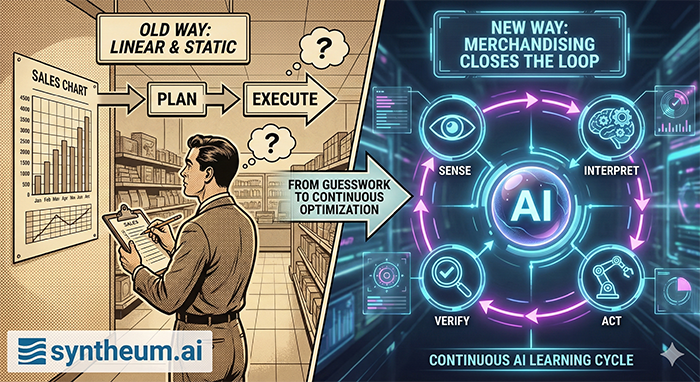
This isn't about a human staring at a dashboard. It’s about a system that loops continuously:
Sense → Interpret → Act → Verify.
How It Works in Practice
Let’s go back to those red sweaters.
-
Sense: The system notices that "red sweaters" are getting impressions in search but zero clicks. It flags this anomaly instantly—not next Monday.
-
Interpret: The AI analyzes the listing. It compares it to competitors. It realizes the main image is not the most popular color compared to the top-performing items, or the price point is $10 higher than the category average.
-
Act: This is the scary part. The system does something. It swaps the main image to the secondary shot. Or it creates a temporary "bundle" offer. Or it adjusts the ranking to push a different red sweater to the top.
-
Verify: It measures the impact of that change over the next 4 hours. If it works, it locks it in. If it fails, it reverts.
Human merchandisers don't disappear in this world. But their job changes. They stop being "shelf stackers" who manually move products around. They become "System Architects." They tune the logic. They decide which metrics the system should optimize for (margin vs. volume).
If your team is still manually sorting category pages in 2026, you aren't merchandising. You're just hobbyists.
The Human Element: Don't Panic
Reading this, it’s easy to feel like the humans are getting squeezed out.
The more we automate, however, the more value there is in the things that can't be automated.
Brand voice. Taste. Curation. The ability to spot a trend before the data sees it.
AI is great at optimizing known variables. It’s terrible at inventing new ones. It can optimize your catalog, but it can't tell you that "Tenniscore" is going to be huge next summer until the search volume already exists.
The best merchants in 2026 will be the ones who let the machines handle the grunt work: the sorting, the tagging, the inventory balancing.
So they can focus on the creative risks that actually build a brand.
Bottom Line
You can't stop this shift.
Shoppers will delegate - but not all in the same way. Some will hand the journey over to full‑blown agents in chat interfaces, while others will lean on lighter, guided assistance embedded in brand experiences sitting right on the storefront. This spectrum of delegation is exactly where your advantage lives, because it’s where you control how much guidance, guardrails, and merchandising logic you expose at each step.
Platforms will charge for that delegation. Agents will need supervision. Checkout will go invisible. And the merchandising loop will close.
The question isn't whether you have the budget for the new tech. The question is whether you have the stomach to change how you work, so you can orchestrate all of these forms of delegation instead of being dragged along by them.
The tools are coming. Get your operating discipline ready.


Empower Merchants with Ease and Intelligence
Syntheum is the Semantic Merchandising Platform for Agentic Commerce - powering onsite search, conversational shopping, and AI discovery through one merchandising brain your team controls.